
Undue Hardship at Work in Texas: ADA Accommodation Rules, Real Examples, and What Employers Must Prove
Undue Hardship at Work in Texas: ADA Accommodation Rules, Real Examples, and What Employers Must Prove
If your employer says, “That accommodation is an undue hardship,” you may feel stuck. Many employees hear that phrase and assume the conversation is over. In most ADA cases, it is not over.
“Undue hardship” has a specific legal meaning. It does not mean “annoying;” it does not mean “inconvenient;” and it does not mean “we do not do that here.”
Under federal disability law, it means the accommodation would cause significant difficulty or expense for that employer, based on the facts of that workplace.
This guide explains what undue hardship means, how the ADA analysis works, and what steps help you protect your rights in Houston and across Texas.

What is undue hardship?
Undue hardship is a defense employers use under the Americans with Disabilities Act (ADA) to deny a requested workplace accommodation. The ADA defines it as an action that requires significant difficulty or expense when you consider specific factors.
Two points matter right away:
- The standard is fact-based. The employer must look at the real cost and the real impact, not guesswork.
- The employer carries the burden. If the employer denies an accommodation as an undue hardship, the employer must support that decision with facts and documents.
“Undue hardship” is not the same as “reasonable accommodation”
Employees often hear two terms in the same meeting: “reasonable accommodation” and “undue hardship.”
- A reasonable accommodation is a change that helps a qualified employee with a disability do the essential functions of the job.
- An employer can deny a requested accommodation only if it creates an undue hardship.
Even then, the analysis does not stop. If one option creates an undue hardship, the employer still should look for another effective option that does not.
ADA coverage basics
The ADA applies to many Texas employers. In most cases, the ADA covers private employers with 15 or more employees, plus state and local government employers. (Texas employers often also face state-law claims depending on the facts, but the federal ADA framework is the starting point for most workplace accommodation cases.)
A common Houston issue shows up here: employees hear “We are too small for that.” Size can matter in the undue hardship analysis, but small does not mean “no duty.” The first step is coverage. The next step is the interactive process.
The interactive process
The law expects an employer and employee to communicate in good faith to find an effective accommodation. Many cases turn on this. If the employer shuts the door fast, or if the employer does not ask basic follow-up questions, that can create risk for the employer.
A practical way to think about it:
- The employee requests help tied to a medical condition.
- The employer asks questions that relate to the job and the limitation.
- The parties discuss options and try a workable solution.
- The employer documents the decision and the reasons.
When an employer claims undue hardship, courts and agencies often look for proof that the employer actually did this work.
The factors that determine undue hardship under the ADA
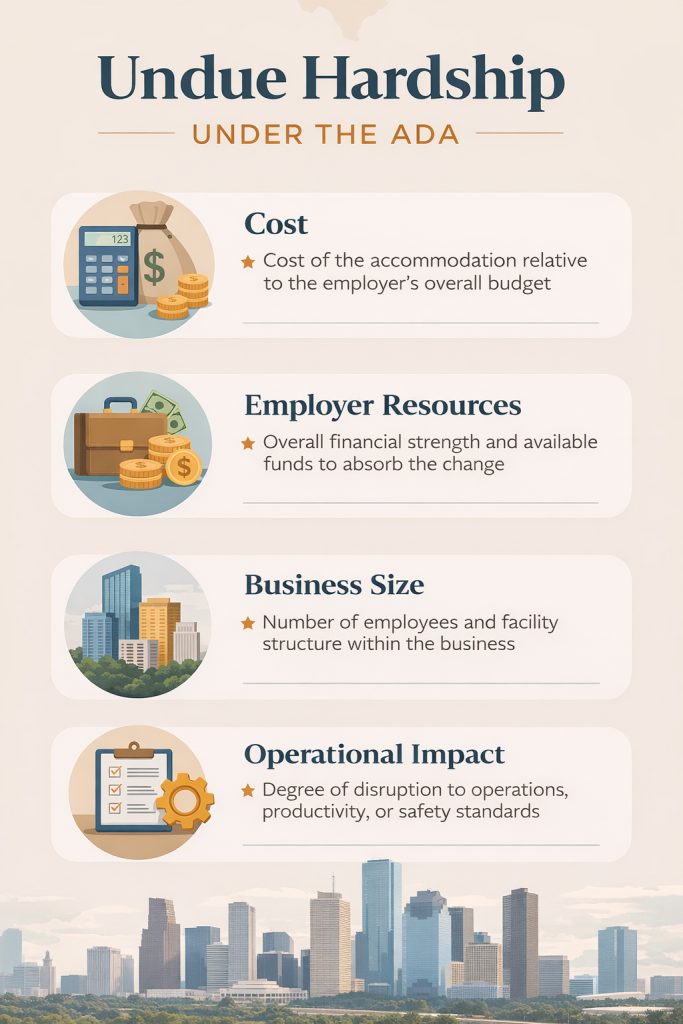
Federal guidance lists factors that help decide whether an accommodation causes significant difficulty or expense. These factors include:
Nature and cost of the accommodation
The employer should estimate real costs. The employer should not rely on vague numbers.
Cost alone is often not enough. Many accommodations cost little or nothing. A widely cited Job Accommodation Network (JAN) study found that 58% of accommodations cost nothing, and many others cost around $500.
The employer’s overall financial resources
A $2,000 change can strain a small company. The same request can be minor for a large company with major revenue. The law looks at resources.
Size and structure of the business
A single facility may have limited budget, but a larger parent organization can matter in the analysis.
Impact on operations
This includes the effect on workflow, safety, and the ability to serve customers. The impact must be meaningful. Minor disruption does not usually meet the standard.
Undue hardship examples that often come up in real workplaces
Undue hardship claims usually fall into a few patterns. Here are common examples, with a Houston lens.
Example 1: Cost that truly strains a small operation
A small employer with limited cash flow may have a stronger argument if an accommodation requires major construction or major equipment costs. The employer needs records that show why the cost creates significant difficulty.
Example 2: Safety problems that the employer can document
A safety-based undue hardship claim works only when the employer can show specific, job-related safety issues. Employers should not rely on fear, guesses, or stereotypes.
Example 3: A change that breaks essential operations
Some jobs require on-site coverage, fixed staffing, or regulated processes. An accommodation that removes a core duty may not be reasonable. The right question is whether another accommodation can keep the essential functions covered.
Example 4: “We tried it, and it failed”
In some cases, an employer agrees to a trial accommodation, tracks results, and shows it did not work. That can support a hardship claim, but only if the employer measured real impacts and explored alternatives.
Examples that usually do not qualify as undue hardship
Many employers use the phrase “undue hardship” for issues that do not meet the ADA standard.
“Other employees will be upset”
Coworker complaints do not equal undue hardship. The employer must show a real operational or safety impact.
“We do not want to set a precedent”
The ADA requires an individualized review. Fear about future requests is not proof of significant difficulty or expense.
“It will be hard to manage”
Management effort alone is rarely enough. The employer must show concrete burden.
ADA undue hardship vs. religious undue hardship
Employees also hear “undue hardship” in religious accommodation disputes. The standard is different because religious accommodation comes from Title VII, not the ADA.
In Groff v. DeJoy (2023), the U.S. Supreme Court explained that an employer must show the accommodation would result in substantial increased costs in relation to the business to deny a religious accommodation as an undue hardship.
So, if you see “undue hardship” in a policy, the legal test depends on the type of accommodation:
- Disability accommodation (ADA): significant difficulty or expense.
- Religious accommodation (Title VII): substantial increased costs (as clarified by the Supreme Court).
The EEOC’s religious discrimination guidance is a helpful reference point for how agencies approach these issues.

How employees can respond when an employer claims undue hardship
If your employer denies your request using “undue hardship,” you can stay calm and get specific.
Ask for the reason in writing
A short email helps. Ask what factor the employer relies on: cost, safety, staffing, or operations.
Ask what alternatives the employer considered
Federal guidance explains that if one accommodation creates an undue hardship, the employer should consider other effective options.
Offer options, not ultimatums
You can propose two or three alternatives; you can propose a trial period; and you can propose a phased change.
Document your work limits and your job duties
You do not need to share your full medical history. You do need enough documentation to show the limits tied to the job.
Do not resign in a rush
If the situation feels like pressure, talk to counsel first. In Texas, the timing of your exit can affect your claims and unemployment issues.
What employers should do to handle undue hardship correctly
I have represented both employees and companies in employment disputes. The best outcomes usually happen when the employer does three things:
- The employer treats the request as a problem-solving task, not a threat.
- The employer documents cost, workflow, and safety with real numbers.
- The employer proposes an alternate accommodation if the first request does not work.
A fast denial with no paper trail is where employers get into trouble.
Houston workplace examples where undue hardship disputes happen often
In Houston, I see these disputes show up in a few settings:
- Health care and clinical operations (staffing and safety arguments)
- Energy and industrial roles (physical demands, shift coverage)
- Logistics and ports (schedule coverage and productivity metrics)
- Office roles in large companies (remote work, modified schedules, equipment requests)
The core rule stays the same. Job title does not control the outcome. The facts control the outcome.
Frequently Asked Questions
What is undue hardship under the ADA?
Undue hardship means a requested disability accommodation would cause significant difficulty or expense for the employer after considering cost, resources, and operational impact.
Is undue hardship hard for an employer to prove?
Yes, in many cases. The employer needs facts and documents, not general claims. Many accommodations cost little or nothing, and cost alone often does not carry the day.
If my employer denies my request, do they have to offer another option?
If one accommodation creates an undue hardship, guidance explains the employer should look for another effective accommodation that does not.
Is undue hardship the same for religious accommodations?
No. Religious accommodations fall under Title VII. The U.S. Supreme Court clarified a “substantial increased costs” framing in Groff v. DeJoy.
Talk with a Houston employment lawyer about your accommodation denial
If your employer denied an accommodation request and used “undue hardship” as the reason, you should get legal advice early. These disputes depend on facts, documents, and timing. A short review of your emails, your job description, and the employer’s stated reasons can reveal a lot.
Attorney Clayton Craighead handles employment disputes for both employees and employers in Houston and across Texas, in state and federal court and in arbitration.
